Closing a funding round is a major milestone. Once the capital is secured, the focus shifts to putting it to work. Organizations need to manage growth initiatives, operational investments, and key milestones while maintaining clear visibility into performance and progress.
As clients move into this next phase of growth and capital execution, leadership teams, investors, and board members shift their focus on runway, spending priorities, and progress against strategic objectives. At the same time, increased activity often exposes the need for stronger operational infrastructure. Reporting processes that supported an earlier stage may require refinement to provide greater insight into financial performance, project spending, and compliance obligations.
The months following a funding round are a good time to strengthen the financial and operational foundation that supports growth. As organizations grow, they often need clearer insight into financial performance, project spending, and compliance requirements to help guide decisions and keep initiatives on track.
What Happens After the Funding Round Is Secured: A Post-Funding Priority Checklist
Closing the round is the milestone. What happens next is where value is created. Once the investment check clears, leadership teams should quickly shift from fundraising mode to execution mode, with a clear focus on protecting capital, increasing visibility, and building the operating discipline needed to support growth.
1. Secure the capital and establish a treasury strategy. The first priority is making sure the cash received is secure. Evaluate banking relationships, determine where funds should be held, and consider high-yield savings, money market accounts, or CDs depending on anticipated runway and liquidity needs. This is also the right time to formalize treasury policies, payment controls, and access levels, so capital is protected while remaining available for planned operating needs.
2. Align on investor and board reporting expectations. Before capital is deployed, confirm how progress will be measured and communicated. Define the reporting cadence, key performance indicators, milestone reporting requirements, and financial and operational metrics investors and board members expect to see. Setting expectations early creates transparency, streamlines future reporting, and helps build confidence with stakeholders.
3. Translate the raise into a detailed capital deployment plan. A strong post-funding model should show how capital will be used across the next 12, 18, 24, or 36 months. Hiring plans, R&D spending, clinical and development initiatives, building or equipment financing and leasing needs, operational investments, and other major milestones should be incorporated into financial forecasts that establish performance expectations, guide investor decision-making, and connect every dollar to strategic objectives and measurable outcomes.
4. Monitor burn rate, runway, and performance against the plan. Cash runway quickly becomes one of the most important metrics for leadership teams, investors, and boards. Regular budget-to-actual reporting helps compare assumptions against actual results, identify shifts in spending patterns or timelines, evaluate how decisions affect near-term objectives and long-term runway, and support timely course corrections before issues become urgent.
5. Create project-level financial visibility. For many life sciences companies, a high-level view of spending is not enough. Capital is often allocated across multiple research programs, clinical initiatives, and development efforts. Project-level reporting helps leadership and investors understand where capital is being deployed, evaluate progress against milestones, assess whether resources are being allocated effectively, and determine whether spending remains aligned with scientific, operational, and business priorities.
6. Build documentation that supports future R&D credit analyses. Detailed project tracking can create value beyond budgeting and forecasting. As organizations invest in research and development, maintaining clear records of project costs, employee activities, and supporting documentation may help support future R&D credit analyses and substantiate eligible activities and expenses. Building that visibility into day-to-day operations is often far easier than attempting to reconstruct it later.
7. Strengthen financial systems, controls, and operating processes. Growth often exposes the limitations of processes that worked well at an earlier stage. As transaction volume increases, teams expand, reporting expectations become more rigorous, and forecasts require more frequent updates, organizations should reassess accounting, payroll, expense management, purchasing, contract management, bill pay, vendor onboarding, and document retention processes. The goal is not to add bureaucracy, but to create a scalable environment where information is accessible, controls are stronger, and routine processes do not depend on manual workarounds.
Building Readiness for Future Opportunities
1. Prepare for diligence and scenario planning before the next opportunity appears. Forecasts are rarely static documents. Hiring plans evolve, research priorities change, development timelines move, and leadership teams may need to evaluate whether to accelerate investment or preserve runway. Regularly revisiting assumptions and maintaining clean records, organized support, and consistent reporting can help organizations respond quickly when financing discussions, strategic partnerships, or acquisition opportunities emerge.
2. Keep equity, valuation, and financing records current. As companies grow, cap tables become more complex, new equity awards may be issued, and prior financing arrangements may introduce additional considerations. Convertible debt, warrants, valuation support, and equity documentation should be maintained and reviewed periodically, so future fundraising, strategic transaction, investor reporting, or audit requests do not require a scramble to reconstruct historical information.
3. Put the right finance leadership and accounting support in place. As operational complexity increases, many growing life sciences organizations need more than day-to-day accounting support but may not yet be ready for a full-time CFO. An outsourced accounting team can help manage financial reporting, compliance requirements, investor reporting support, audit readiness, and transactional processes, while fractional CFO support can help manage runway, refine financial models, evaluate growth scenarios, support board reporting, and guide strategic decision-making during critical growth periods.
The bottom line: The period immediately following a funding round is when financial discipline, reporting visibility, and operational execution become just as important as the raise itself. Companies that secure capital, deploy it intentionally, monitor performance, and build scalable infrastructure early are often better positioned to maximize runway, achieve milestones, and prepare for the next round of opportunity.
Further Reading
For a deeper look into business process assessment, system selection, and implementation considerations:
Putting This Into Practice: Life Sciences Leadership
AAFCPAs works with companies at every stage of the growth cycle, helping leadership teams strengthen reporting, improve forecasting, enhance financial visibility, and build the infrastructure needed to support expansion. Through our Outsourced Accounting & Fractional CFO Solutions, we provide scalable accounting, finance, and strategic advisory support designed to evolve with an organization’s needs. As companies prepare for future fundraising activities, strategic transactions, or other significant milestones, valuation considerations can become increasingly important. Our business valuation specialists help organizations understand and support value through analyses designed to withstand scrutiny and support informed decision-making. Drawing on decades of experience serving the life sciences industry, AAFCPAs helps companies align financial operations, governance practices, and growth objectives so they are well-positioned for whatever comes next.
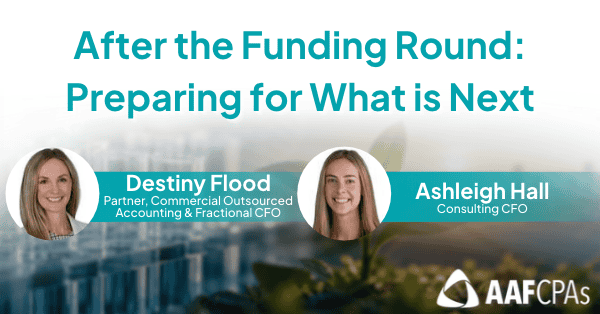
These insights were contributed by Destiny J. Flood, CPA, Partner, Commercial Outsourced Accounting & Fractional CFO and Ashleigh Hall, CPA, Consulting CFO.
Questions? Reach out to our authors directly or your AAFCPAs partner.
AAFCPAs offers a wealth of resources on life sciences growth strategies. Subscribe to get alerts and insights in your inbox.