




Technology & Process
What Your UFR Process Is Telling You
Finance leaders can learn a great deal from the way information moves through their UFR process. Understanding those patterns can help identify opportunities to strengthen…
Align technology with business strategy to reduce costs, strengthen performance, and support long-term success.

 Aligning technology investment with business strategy
Technology drives how an organization operates, innovates, and grows. But unchecked, it can become a major cost center and a source of inefficiency. IT investments that fail to meet functional needs, duplicate existing solutions, or are quickly outgrown can drain budgets and distract leadership from core priorities. IT Strategic Planning helps organizations take control of technology spending through value-driven system investments, integration, and optimization. This ensures infrastructure and teams are positioned to support both immediate operations and long-term goals.
AAFCPAs partners with executive, management, and IT teams (including outsourced providers) to assess the IT environment, identify underused or overlapping technology, and highlight opportunities to improve oversight and efficiency. The process captures a clear snapshot of current IT strengths and gaps, aligns initiatives with organizational objectives and strategic vision, and provides guidance and recommendations to help leadership manage costs, reduce risk, and better position technology resources for the future.
As part of strategic IT planning, organizations must also ensure that sensitive data such as personally identifiable information (PII) and protected health information is properly secured and governed, including alignment with HIPAA compliance requirements.
We begin by evaluating the full IT environment, including hardware, software, cloud services and subscriptions, IT staff and contractors, maintenance and support, and cybersecurity measures. Next, we review the organization’s five-year strategic plan alongside the IT department’s five-year strategy to understand how current and planned investments align with broader goals. If no IT strategic plan exists, we help develop a tailored one based on your objectives. Recommendations may include initiatives to streamline operations using digital transformation and AI and intelligent automation, allowing clients to seize opportunities to do more with less.
Technology teams are often consumed by the day-to-day—reactive helpdesk tickets, routine maintenance, managing legacy systems, and user onboarding or offboarding. They also face vendor and license management, security response, and ad hoc requests. These operational demands leave little room for higher-level priorities, such as planning digital transformation, evaluating emerging technologies, aligning IT with business goals, or designing future-proof systems architectures.
AAFCPAs provides additional bandwidth, streamlines repetitive tasks through automation, and leverages fractional leadership, including fractional Chief Information Officer (CIO) or Chief Information Security Officer (CISO) support, to help teams focus on strategic initiatives. Whether you need an outsourced Chief Technology Officer (CTO) or sharper oversight of IT operations, we partner with leadership to create sustainable value from technology investments today and into the future. This includes evaluating the IT team’s capacity to execute strategy, assisting with hiring and training, and ensuring the right structure, staffing, and expertise are in place to execute strategy effectively, manage risk, and respond to evolving priorities.
 A structured, repeatable approach to IT alignment


 Our Advisors
 TRENDING NOW
Stay up-to-date on trending topics, fresh perspectives, in-depth analysis, and regulatory alerts that affect your business.
Finance leaders can learn a great deal from the way information moves through their UFR process. Understanding those patterns can help identify opportunities to strengthen…
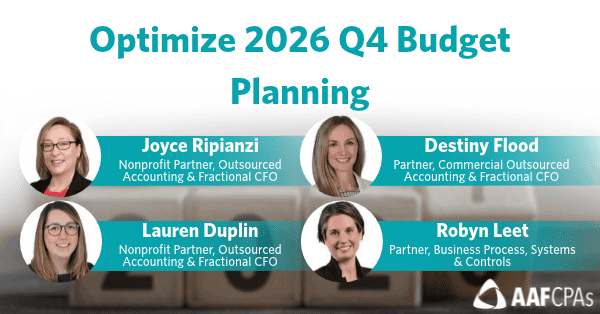
Annual budgets establish direction. Forecasts keep plans grounded in current realities. Together, they help leadership teams navigate uncertainty and prepare for the opportunities and challenges…

Many organizations invest significant time and resources maintaining processes built around aging systems. Understanding those operational costs can lead to more informed technology decisions.
CONTACT US
Every situation is unique. We look forward to speaking with you to determine how we may best solve your needs.

