During the fourth quarter, organizations have an opportunity to evaluate financial performance, finalize plans, and set priorities for the year ahead. It is a time to refine budgets, align resources with strategic objectives, and prepare for opportunities and challenges on the horizon. A well-developed budget provides a framework for decision-making, helping leadership teams allocate resources, establish financial targets, and move into the new year with greater clarity around organizational priorities.
The Value of Budgets and Forecasts
Budgets and forecasts serve different, but closely connected, roles in financial planning. The annual budget establishes the organization’s operating plan, translating strategic priorities into expected revenue, expenditures, investments, and resource allocation decisions. It provides a framework for evaluating performance and managing against agreed-upon objectives throughout the year.
Forecasts add an ongoing layer of insight by incorporating actual results, emerging trends, and changing assumptions. As conditions evolve, forecasts help leadership understand whether performance remains aligned with expectations and where adjustments may be warranted. Many organizations use rolling forecasts that extend beyond the current fiscal year, providing greater visibility into future financial conditions and supporting more informed decision-making.
The greatest value often comes from viewing budgets and forecasts as part of the same planning conversation. A budget reflects the organization’s expectations at a particular moment in time. Forecasting keeps that conversation current, incorporating actual results and emerging developments as the year unfolds. As organizations prepare for the year ahead, the relationship between the two can bring important questions into focus and provide leadership with a stronger foundation for financial decision-making.
The Assessment Phase
Before diving into budgeting, ask yourself: How is the current year progressing? Are you on target to meet revenue and expense projections? What financial challenges have emerged, and how might they be addressed? By reviewing the current year’s performance, leaders can make necessary adjustments to the budget to ensure alignment with actual results. Assessment should also include identifying which costs are fixed or variable in nature. This exercise will provide insight for both the budget and forecast process.
As organizations develop budgets for the coming year, it is also important to establish realistic revenue assumptions. While new information will emerge throughout the year, continually revising revenue targets during the budgeting process can make planning more difficult and create uncertainty around strategic priorities. A well-developed budget creates a stable framework for planning and decision-making throughout the year. Forecasts, scenario planning, and periodic reforecasting can then be used to evaluate actual results, adjust expectations, and inform decision-making without losing sight of the organization’s original financial objectives.
The assessment phase also requires an impartial analysis of broader economic and industry trends that may affect financial planning. By considering these factors, leaders can plan for external influences like changes in market conditions, shifts in consumer behavior, or regulatory updates that may impact revenue streams or operational costs. Understanding these forces can help leaders evaluate whether current assumptions remain reasonable and where additional planning may be warranted.
Once key assumptions have been established, scenario planning can help organizations evaluate a range of potential outcomes. Beyond preparing for specific situations, the process can help leaders identify risks, evaluate opportunities, challenge assumptions, and better understand the factors most likely to influence future performance. For example, organizations might model how the loss or award of a major grant, the addition of a significant customer contract, changes in demand, supply chain disruptions, or key staffing transitions would affect revenue, expenses, and cash flow. Evaluating these possibilities in advance helps identify trigger points that may require action and provides leadership with a practical framework for adjusting spending, staffing, investments, or operational plans if circumstances change.
Incorporating Strategic Changes
As operations move into a new year, it is important to then integrate known strategic changes into the budget. These might include new investments, lost revenue streams, or organizational restructuring. Any major changes that could affect income, expenses, or capital allocation should be factored into the budget planning process.
For example, if an organization plans to launch a new product or service, additional funding may be required for marketing, research, or infrastructure. Similarly, if a significant personnel change is anticipated—such as hiring new staff or offering salary increases—those expenses must be accounted for. Incorporating such changes into the budget ensures resources are properly allocated to support the organization’s strategic vision in the year ahead.
Growth Plans and Key Budget Areas
Growth planning is a key component to Q4 budgeting. Whether expanding into new markets or programs, investing in technology, or increasing staff, it is important to have a clear strategy for growth and a corresponding budget that supports this vision. Identifying specific areas where you anticipate growth allows for targeted investments and ensures resources are allocated to the most impactful initiatives.
When allocating resources, focus on key areas like staffing, marketing, technology, and capital expenditures. Each of these areas can significantly affect the overall budget, so you want to ensure there is enough financial flexibility to support growth without straining existing operations. By planning in advance, leaders can set themselves up for success and ensure growth goals are both realistic and attainable.
Creating a comprehensive budget requires input from several key members within the organizations. Depending on size and complexity, this may include executives, department heads, or financial managers. These individuals are best equipped to provide insight into their respective areas, identifying potential costs and opportunities that could affect the budget.
In some organizations, the budget is a collaborative effort that incorporates input from various departments or units. It is essential that these contributors provide realistic estimates, outline key assumptions, and identify any potential risks. Gathering early input also helps to secure buy-in from those who will be responsible for implementing the budget, ensuring alignment across the organization and fostering a greater sense of ownership over financial goals.
How Annual Budgets Drive Cash Flow Decisions
An annual budget not only provides a clear financial plan but also plays a critical role in managing cash flow. By projecting expected income and expenses, organizations can determine if they have sufficient cash to meet obligations and invest in key initiatives. This proactive approach ensures cash flow decisions are based on a clear understanding of their financial position.
For both nonprofits and commercial organizations, the budget offers valuable insight into when cash will be needed for specific expenditures. For example, if a nonprofit organization has a large grant payment coming in early next year, the budget can help forecast when those funds will be available and how they can be used most effectively. Similarly, for a commercial enterprise, a well-planned budget can identify periods of cash surplus or shortage, helping to make more informed decisions about financing, investments, and operational adjustments. Keep in mind that it is beneficial for some organizations to have two versions of forecasting, one for revenue and expense and one for cash flow timing. The two can work in parallel to provide valuable insight on future needs and ability to meet budget and other goals.
Many organizations are moving beyond spreadsheets to cloud-based platforms that offer automation, real-time tracking, and data visualization. These platforms not only streamline the budgeting process but also enable continuous updates as financial projections evolve, giving business leaders an up-to-date view of financial performance.
Tools like predictive analytics software, for example, play a critical role in budgeting. By leveraging data, these technologies can help forecast potential cash flow challenges and align budgets with growth projections. Additionally, machine learning algorithms in some platforms analyze patterns and help decision-makers make informed adjustments to spending.
A few organizations also adopt industry-specific software to enhance reporting accuracy, particularly for complex financial landscapes. With automation at the core, these tools reduce manual errors and increase overall accuracy. Whether an organization is seeking a comprehensive tool for long-term strategic planning or a real-time budgeting assistant, technology now offers solutions that align with diverse business needs.
Further Reading
For a deeper look into the processes, technologies, and financial strategies that support effective budgeting and organizational performance, explore these related resources:
Putting This Into Practice: Budget Strategy & Forecasting
Budgeting is often one of the most time-intensive responsibilities facing leadership teams, particularly when plans need to adapt as conditions change throughout the year. AAFCPAs’ Outsourced Accounting & Fractional CFO (OAFC) practice helps organizations strengthen financial planning, gain deeper visibility into performance, and make decisions with greater confidence through services that include strategic financial leadership, budgeting and forecasting, cash flow management, growth planning, capital raising, and other specialized advisory support. Organizations seeking a more efficient budgeting process may also benefit from our cloud-based budgeting solution, which provides a collaborative environment where stakeholders can develop, review, and refine budgets in real time while maintaining a clear view of financial performance.
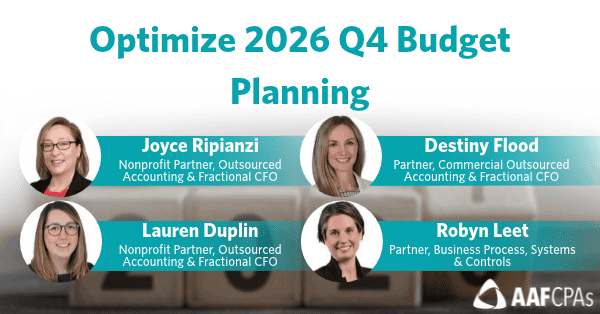
These insights were contributed by Joyce Ripianzi, CPA, Nonprofit Partner, Outsourced Accounting & Fractional CFO, Destiny J. Flood, CPA, Partner, Commercial Outsourced Accounting & Fractional CFO, Lauren M. Duplin, CPA, Nonprofit Partner, Outsourced Accounting & Fractional CFO, and Robyn Leet, Partner, Business Process, Systems & Controls.
Questions? Reach out to our authors directly or your AAFCPAs partner.
AAFCPAs offers a wealth of resources on financial management strategies. Subscribe to get alerts and insights in your inbox.