Progress in the life sciences is often measured one milestone at a time. A funding round supports the next phase of development. Clinical advancement creates new opportunities and new expectations. Even successful periods can feel temporary, with attention already shifting to the next objective.
That pace is one reason artificial intelligence is gaining traction across the sector. Teams are exploring how it can help analyze data, accelerate research activities, and free up time for work that depends on expertise and judgment. As new tools become more accessible, AI is increasingly finding its way into day-to-day operations throughout the business.
Leadership teams are evaluating those developments in the context of broader business priorities. Protecting intellectual property, managing sensitive information, maintaining appropriate oversight, and supporting innovation all carry importance. Understanding how AI fits into that environment is becoming part of ongoing discussions about growth, stewardship, and long-term value creation.
How AI Is Accelerating Life Sciences Innovation
The pressure to move quickly is nothing new in the life sciences. What is changing is the set of tools available to support that pace.
Teams are using AI to analyze data, summarize information, accelerate research activities, and reduce time spent on routine work. As technology continues to improve, many firms are finding opportunities to increase capacity, reduce development cycles, support decision-making, and make better use of existing resources.
The impact is not always dramatic or immediately visible. In many cases, adoption occurs through incremental changes to everyday work. An employee begins using AI to summarize reports. A team incorporates it into research workflows. A department identifies opportunities to automate repetitive tasks. Over time, those individual decisions can reshape how information moves through the business and how work gets done.
That reality is prompting leadership teams to look beyond individual use cases and consider a broader question: where can AI create meaningful value? The answer often depends on the nature of the work. Activities involving research findings, financial reporting, strategic planning, or communications with investors and regulators carry different expectations around oversight and review. Understanding those distinctions can help leaders evaluate where speed creates an advantage and where additional scrutiny remains appropriate.
Many firms are also finding value in establishing visibility before expanding into broader AI initiatives. Understanding how AI is currently being used, what information may be entering those systems, and where outputs are influencing decisions can provide a useful foundation for future planning.
Those conversations carry particular weight in the life sciences. Research findings, proprietary knowledge, and data accumulated over years of work often represent some of a company’s most valuable assets. As AI becomes more deeply embedded in everyday workflows, leaders are evaluating how those assets are handled, what safeguards exist around their use, and how technology can support continued innovation while preserving confidence in the information that drives critical decisions.
Faster decisions. Stronger guardrails.
Speed creates value only when decision-makers maintain confidence in the information behind it. AI can summarize information, identify patterns, and generate output in seconds. Those capabilities can help accelerate work throughout the organization, but they cannot eliminate the need for review, context, or professional judgment. In many cases, they increase its importance.
Research findings, financial analyses, strategic recommendations, and operational decisions each carry different expectations around accuracy, documentation, and accountability. Leaders often benefit from considering where AI-generated output can support those activities and where additional review should remain part of the process.
That conversation frequently extends beyond the output itself. Information entering AI systems deserves the same level of attention. Proprietary research, intellectual property, clinical information, and other sensitive data may require different safeguards depending on how tools are being used and configured and where the data is being stored.
For many life sciences leaders, the objective is creating confidence. Clear expectations around data usage, output review, and accountability can help employees use AI effectively while supporting the standards the organization already applies to research, operations, and decision-making. As adoption expands, those practices often become an important foundation for scaling AI in a deliberate and sustainable way.
Building an AI Governance Framework for Life Sciences
Many life sciences companies are still in the early stages of their AI journey. In some cases, as mentioned earlier, adoption is occurring through individual teams and departments identifying practical ways to improve efficiency. In others, leadership teams are beginning to evaluate how AI fits within broader business objectives.
As usage expands, many organizations find value in establishing a shared framework for how AI is used across the business. Policies, governance practices, employee education, and clear expectations can help create consistency while providing greater visibility into how information is being handled and how outputs are influencing decisions.
Those conversations often begin with foundational questions. What tools are approved for business use? What information should and should not be shared with AI systems? When is additional review required? How should employees evaluate AI-generated output before incorporating it into their work?
The answers will vary across organizations. A company managing proprietary research, clinical information, or other sensitive data may have different requirements than a business using AI primarily for administrative support. The objective is not to create unnecessary complexity but, instead, to establish expectations that support innovation while reflecting the realities of how the organization operates.
As AI capabilities continue to evolve, governance can provide a mechanism for adapting alongside them. A framework that defines accountability, supports informed decision-making, and promotes responsible use may help organizations evaluate new opportunities with greater confidence while maintaining consistency across teams.
Putting This Into Practice: Smart Automation, AI, and RPA
AAFCPAs helps you identify where artificial intelligence and robotic process automation can create meaningful business value within your organization. Whether you’re exploring ways to improve financial reporting, streamline operational processes, enhance decision-making, or make better use of limited resources, we work with you to evaluate opportunities, prioritize initiatives, and implement solutions that align with your goals. Our approach combines practical automation strategies with thoughtful attention to governance, security, data stewardship, and change management, helping you pursue efficiency and innovation with confidence while preparing your organization to scale and adapt as technology continues to evolve.
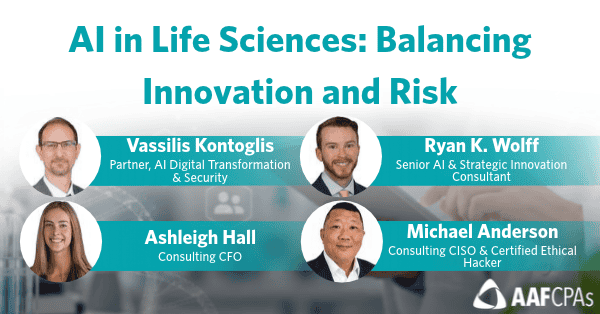
These insights were contributed by Vassilis Kontoglis, Partner, AI Digital Transformation & Security, Ryan K. Wolff, MBA, Senior AI & Strategic Innovation Consultant, Ashleigh Hall, CPA, Consulting CFO, and Michael Anderson, MCSE, CCNP, CISSP, CEH, Consulting CISO & Certified Ethical Hacker.
Questions? Reach out to our authors directly or your AAFCPAs partner.
AAFCPAs offers a wealth of resources on smart automation, AI, and RPA. Subscribe to get alerts and insights in your inbox.