




A PROLOGUE TO THE STORY…
As we sat down to pen this latest quarterly newsletter, we couldn’t help but think of the opening scene of the movie The Big Short (2015).
“IT AIN’T WHAT YOU DON’T KNOW THAT GETS YOU INTO TROUBLE. IT’S WHAT YOU KNOW FOR SURE THAT JUST AIN’T SO.” – MARK TWAIN
The film, based upon Michael Lewis’ best-selling novel, chronicles the events that led to the Great Financial Crisis of 2008-2009. In the years following the crisis, much attention was given to determine the cause of this near collapse of our economic system. The postmortem identified many contributing factors: subprime lending, immodest investments, deregulation, risk run amok on Wall Street, etc. The overriding theme that bound these all together can best be described as a cumulative failure of public policy.
We now find ourselves in an unpleasant, familiar place, with speculation of a recession related to failed attempts by the world’s central banks to overcome the aftershocks of the global economic shutdown of 2020.
It’s important to set the stage for where we are today by revisiting seminal events that occurred over the past two and half years.
2020 – THE COVID SHUTDOWN & GOVERNMENTAL RESPONSE…
As we reflect on the spring of 2020, we must consider the global response of various governments and central banks to reduce the negative financial impact the pandemic had on so many lives. Within a month’s time, we had gone from operating “business as usual” to living in a locked-down state that prohibited most individuals from leaving their homes.
As economic output essentially dried up, central banks around the world developed stimulus packages to augment income for those who lost their jobs and/or experienced reductions in income. The U.S. alone accounted for nearly $7 Trillion dollars in federal spending, tax cuts, loans, grants, and subsidies. Put another way, approximately 40% of U.S. dollars that exist today were generated in one form or another as a result of the economic issues that tie directly back to the pandemic.
Outside the U.S., the rest of the world’s collective response amounted to another $8 Trillion dollars, bringing the total global response to more than $15 Trillion dollars in aid. Additionally, most central banks lowered interest rates, thereby reducing the cost to obtain capital. Combine these massive amounts of new money in the system, with extremely low interest rates spurring on consumerism, and the backdrop is set for an increase in inflation.
2021 – THE GREAT REOPENING & ROLE OF GLOBAL CENTRAL BANKS…
Optimism was on the rise as we headed into 2021 and cautiously hoped for an economic jump start. Pent up demand and cabin fever unleashed a torrent of spending as we slowly began to resume life as usual. By late spring, economic concerns morphed from worries over the enormous contraction in GDP to debating whether inflation would be transitory or more ‘sticky’ in nature. In a high stakes game that would set the tone for years afterward, investors the world over placed their bets, possibly taking clues from central bankers. As for their part, the U.S. Federal Reserve bet ‘the under,’ so to speak, as Jerome Powell would go on to infamously state that inflation was transitory, a mere by-product of global supply chains having been fouled up. Powell’s transitory premise was built upon the argument that as supply chains returned to normal over time, inflation would abate, and we’d return to our usual ~2.5% level from the 5% reading at that time.
However, as 2021 unfolded, the concerns around inflation continued to ring louder. By year end, the Consumer Price Index (CPI) had reached 7%, leading to the single largest yearly increase in the measure since 1982, thereby forcing the Federal Reserve to finally capitulate and change its tone. The idea that inflation would be a short-lived nuisance was dropped and was replaced with the idea that it had become enemy number one given its ability to derail the nascent economic recovery. Cited as one of the two biggest threats to getting back to maximum employment, Powell stood before Congress in December and committed to breaking the back of inflation in 2022.
2022 – THE FED GETS TOUGH…
In January of this year, the markets began to account for an inflationary environment. True to their word, the Federal Reserve raised the Federal Funds Interest Rate by 0.25% in March and followed suit during the next four FOMC meetings (Federal Open Market Committee) thereafter (graph below).

Additionally, the Fed undertook an entirely new program known as Quantitative Tightening (QT). In short, QT is the process whereby the Fed discontinues open market purchases of government bonds and unwinds their own balance sheet to stop suppressing interest rates. This program was started in earnest in June, thereby allowing for the combination of these three actions to not only increase short-term borrowing costs, but also allow the longer-term bond market to find its proper level for longer duration rates. The cumulative actions of the Fed have been nothing short of historic in their attempts to quell inflation; and the markets, be they equity, fixed income, commodity, housing, and even currency related, have all taken notice.
…AND THE MARKET RESPONDS
With hopes dispelled about inflation being transitory, investors began to reposition their portfolios for a more drawn-out fight. Forced to reconcile higher and higher monthly CPI prints with data possibly showing recession, and yet an incongruously strong job market, many investors chose to shoot first and ask questions later, bringing us up to present day.
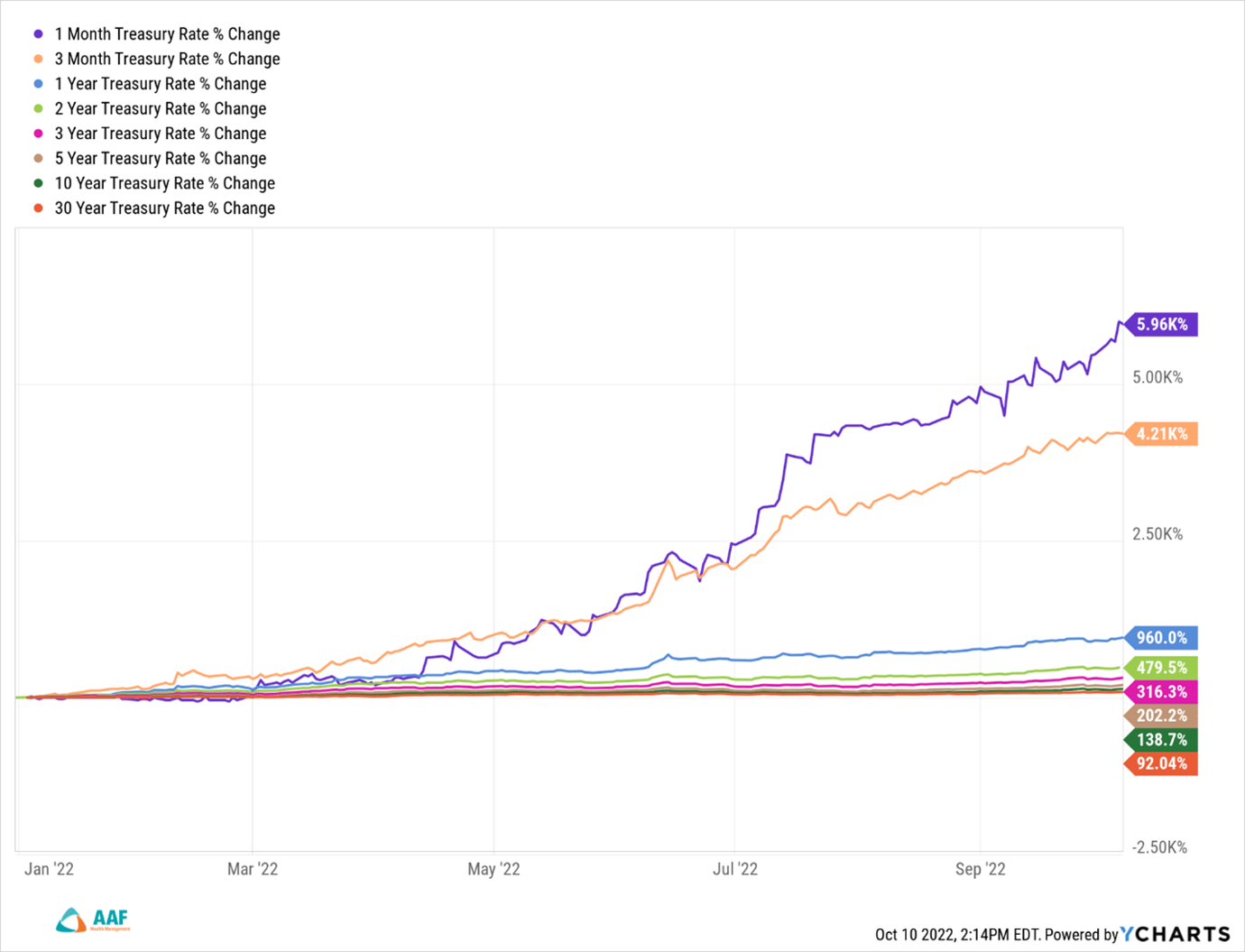
With fears of inflation becoming more entrenched, we witnessed a rarity in the markets where both bonds and stocks have sold off at the same time. And not only have both asset classes taken on losses this year, but we’re at the point where both equities in general, and certain categories of fixed income instruments are down more than 20% year to date. For the first time on record, the US Treasury market has failed to serve as a hiding place for risk as interest rates have risen at an unfathomable pace. You don’t need to be an expert in the nuances of the bond market to understand that a 5,960% change in 1 Month U.S. Treasury rate is something out of the ordinary.
As for stocks, while the prevailing thought normally is that equities may offer the only real opportunity to maintain purchasing power in an already high-cost world, many investors have eschewed that notion for fear that stocks, too, may also become less attractive to “cash is king” alternatives, as the interest rates on fixed investments (CDs, money markets, etc.) have posted their most attractive yields in more than a decade and a half. With a “bird in the hand” mentality having become the norm this year, nearly every major category of investments, save commodities, have sold off.
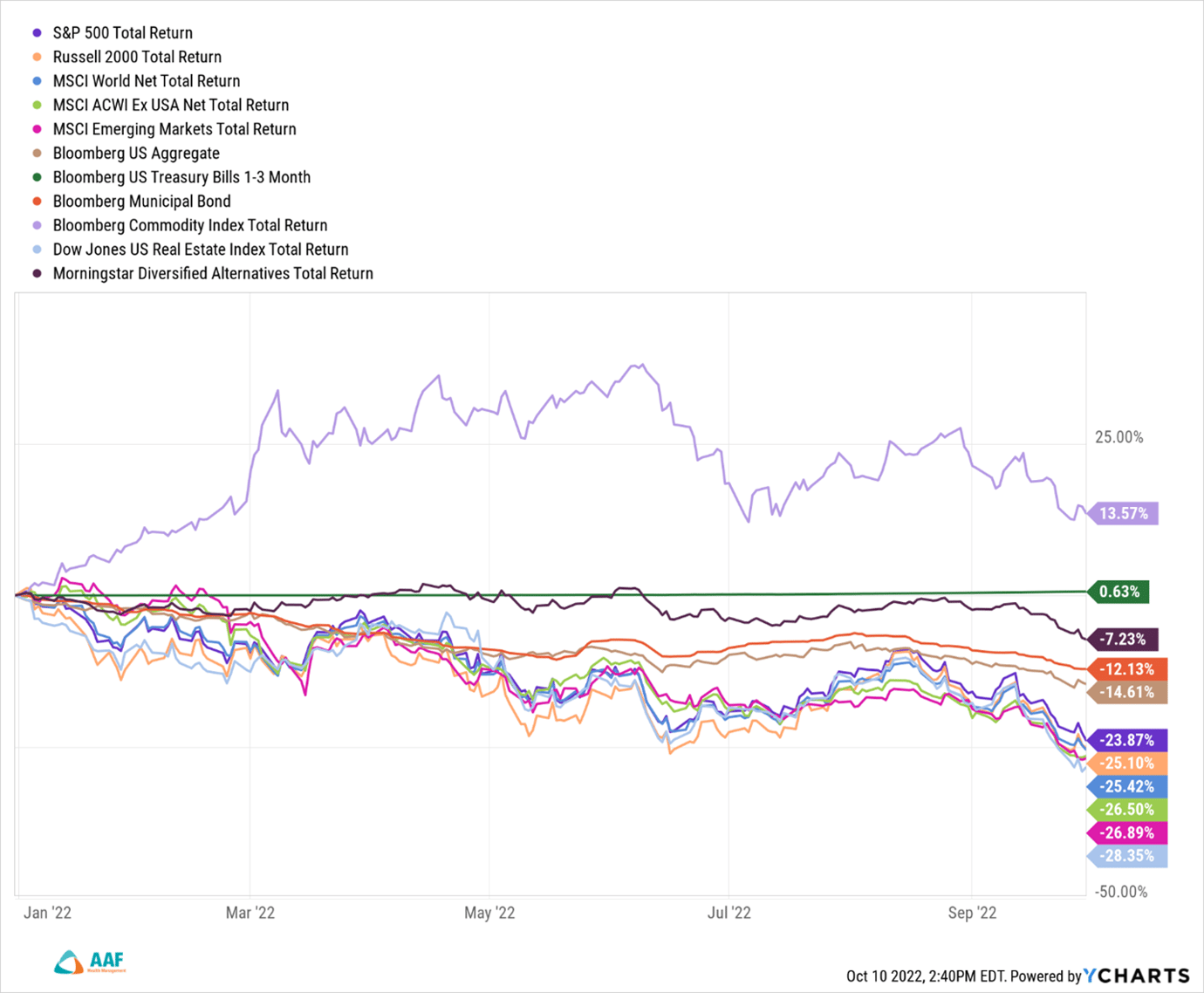
Unfortunately, we are now bearing witness to one of the worst years on record for a properly diversified portfolio. In fact, at this point in the year, 2022 is registering as the 5th worst investment year on record since 1793.
OUR RESPONSE TO 2022…
It is times like this when investors question their approach to making money in the markets, putting history aside, and instead wondering if THIS time actually IS different.
No one knows when this slide will end, but if history is an indicator, the markets will return to their longer-term averages. In the interim, AAF Wealth Management continues to maneuver our portfolios in defensive ways to try and absorb as much of the economic pain as we can while we wait for the recovery. Specifically, we have taken steps both earlier in the year (January), as well as more recently (in August) to position away from both longer-term bonds and high multiple growth stocks, in favor of short duration and stable, high quality balance sheet assets.
And even though we’re not inclined to simply sell and go to cash, we do make tactical changes to try and reduce the financial pain we and our clients are experiencing.
From a broad perspective, our reallocations have generally fallen into the following categories:
- Reducing the duration of our bond positions to minimize interest rate sensitivity
- Reducing US growth exposure in lieu of more defensive, value-oriented stocks
- Adding both to the total percent invested in, as well as the number of alternative investments within the portfolio
- Reducing international emerging markets exposure
- Adding international high dividend exposure
- Increasing defensive positioning in late cycle sectors, such as Health Care
- Adding to alternative fixed income positions via exposures in floating rate loans, preferred stocks, and convertible bonds
Additionally, clients for whom we manage taxable accounts, we seized the opportunity to reduce taxation (in this year and/or the future) by tax loss harvesting via sales of securities that were showing negative returns. While unpleasant to view on a statement, losses can be used to offset future taxable gains, and with a heritage closely tied to the world of tax and accounting, we are very cognizant of the tax opportunities available to our clients in a year like 2022.
LOOKING FORWARD FOR GLIMMERS OF HOPE…
As stewards of our clients’ money, our job is to scan the horizon for risk & opportunity, and as much as possible position for storms as they arise. While certainly not an easy task this year, we do continually monitor the economic landscape for changes in earnings estimates, interest rates, GDP, inflation, and the like.
Over the following week or so, earnings season will begin in earnest and companies will start to declare their business results for Q3 2022. It’s with a keen eye that we monitor these releases for data points that may give clues as to where this year is trending, and how we should subsequently position portfolios for the future.
With all sincerity, we understand the concerns investors may be feeling and share in their frustrations with the market’s performance this year. As professional investors, clients chose to hire us for our ability to make calm, rational decisions to help with the long-term growth of their assets. To that end, we continue to survey the investment landscape.
*AAF Wealth Management is a Registered Investment Adviser. Advisory services are only offered to clients or prospective clients where AAF Wealth Management and its representatives are properly licensed or exempt from licensure. This blog is solely for informational purposes. Past performance is no guarantee of future returns. Investing involves risk and possible loss of principal capital. No advice may be rendered by AAF Wealth Management unless a client service agreement is in place.
Team members in AAFCPAs’ Human & Social Services Pod enjoyed an end of summer 2022 get together, hosted by partners Jeffrey Cicolini, Tom Muldoon, and Katie Belanger.
To do your best work, you first must be able to witness and evaluate your thoughts, rhythms and emotions. Self-reflection is important to understanding how you do your best work. I use the term best work, but what I really mean is engaged, happy and productive. Reflective questions to ask yourself include…
AAFCPAs is pleased to introduce and share our second annual Impact Report, which outlines the firm’s 2021 actions and 2022 goals as it relates to AAFCPAs’ Social Purpose: We believe business is the conduit for social change! We want to improve the world. We aspire to do so with our actions, which speak louder than words. We hold each other accountable to promote kindness.
LinkedIn Pulse (March 9, 2022) – What I Learned: Moving AAFCPAs to a Work from Anywhere Model “Where there are challenges, there are opportunities to learn. We announced our #workfromanywhere model last year with clear guidelines to help shift our mindset,” said Carla McCall, AAFCPAs’ Managing Partner. “It takes work, but it can work. We are proof – AAFCPAs is a 270+ person professional service firm with clients and staff all over the country!”
AAFCPAs would like to make cannabis clients aware of an emerging issue with the use of cashless ATMs. Visa Inc. issued a memo in December 2021 to customers, and reported in Marijuana Moment, warning that “miscoding point-of-sale transactions through the use of so-called cashless ATMs—a practice used by some cannabis retailers as a workaround to accept credit or debit cards for purchases—could lead to penalties or other unspecified enforcement action.”
AAFCPAs advises clients using Cashless ATMs to review the processes of their financial providers and to ensure you are using appropriately registered, regulated, compliant, and reporting solutions.
We continue to monitor ever-changing developments in federal legalization & banking reform. If you have questions, please contact David McManus, CPA, CGMA at 774.512.4013, dmcmanus@aafcpa.com; or your AAFCPAs Partner.
AAFCPAs was an industry pioneer and since 2012 has been deeply immersed advising cannabis businesses in tax, finance, and outsourced accounting! With national recognition, our multi-disciplinary team of advisors include CPAs, CFOs, estate planning & tax attorneys, wealth advisors, as well as business process, data analytics, IT, and cyber security professionals.
Forbes (12.2.21) – AAFCPAs (Westborough, Boston, Waltham, MA) is Among America’s Best Tax And Accounting Firms! Forbes partnered with market research company Statista to create a list of the most recommended firms for tax and accounting services in the U.S. based on surveys of tax and accounting professionals and their clients. Approximately 4,400 recommendations were considered in the final analysis.
Boston Business Journal (12.23.21) – It’s been a decade since Carla McCall started an initiative to help women reach leadership positions at the accounting firm AAFCPAs. McCall spoke to the Business Journal about her efforts at AAFCPAs and elsewhere to combat inequality, and to look ahead at a time when companies are generally still instituting new policies around hiring and promotions.
In 2016, FASB issued Accounting Standards Update (ASU) 2016-02, Leases (Topic 842) to increase transparency and comparability of lease transactions. AAFCPAs has summarized some of the most significant changes resulting from the new ASU for your convenience:
AAFCPAs has provided a detailed Whitepaper providing guidance on the FASB’s new Lease standard so clients may proactively consider the impact on their current and future operations. This Whitepaper outlines the significant changes resulting from the new ASU, including: a comprehensive outline of the scope of the new lease standard, effective dates, disclosure requirements, and practical considerations for lessees and lessors. Click here to download AAFCPAs’ Lease Accounting Whitepaper. >>
- Operating leases will now be recorded in the balance sheet as assets and liabilities if the lease term is greater than 12 months. Prior to this new standard, U.S. GAAP required only capital leases to be recognized on the balance sheet. This recognition of lease assets and lease liabilities by lessees for those leases classified as operating leases under existing GAAP is a very significant change to all reporting entities and will need significant analysis and evaluation.
- For leases with a term of 12 months or less, a lessee is permitted to make an accounting policy election not to recognize lease assets and lease liabilities, and recognize the lease expense generally on a straight-line basis over the lease term.
- The new standard makes a distinction between “operating leases” and “finance leases.” For operating leases, the lessees will recognize a “right-of-use” asset and a lease liability, initially at the present value of the lease payments, which represents the right to use the underlying asset during the term of the lease. The lease cost is calculated so that the cost of the lease is allocated over the lease term on a generally straight-line basis. For finance leases, the lessee will similarly record the right-of-use asset and a lease liability, again at the present value of the lease payments. However, interest on the lease liability is recognized separately from the amortization of the right-of-use asset. The cash payments related to operating leases are reflected in the operating section of the statements of cash flow. Cash payments related to the principal portion of a financing lease is classified in the financing activities, and payments of interest are reflected within operating activities of the statement of cash flows.
The lessor accounting is not significantly changing and will follow the new revenue standard.
This ASU applies to all entities that enter into a lease.
This change takes effect for fiscal years beginning after December 15, 2019, for non-public companies. Early application of the new lease standard is permitted for all entities.
What does AAFCPAs advise?
 In order to estimate how this change will affect your business, we recommend that you summarize all of your operating leases and consider the impact they will have on your financial statements. If the impact on your balance sheet is potentially significant, you may want to:
- Calculate your loan covenant ratios using your balance sheet as adjusted for these accounting changes to make sure you are still in compliance.
- Amend existing loan agreements so the loan covenants exclude any impact from lease accounting rule changes.
- Modify or change existing loan covenant definitions and calculations to specifically exclude capital leases.
- Look at the impact of these changes to your expenses and the subsequent impact on any contracts, compensation agreements, etc.
- Consider if it still makes sense to lease instead of buying the asset.
- Estimate the effect of this change on the timing of your expenses and re-forecast your financial results to see the full impact of the change.
With respect to the transition to the new guidance, lessees and lessors are required to recognize and measure leases at the BEGINNING of the earliest period presented in the financial statements, using what is termed: a “modified retrospective approach.” The modified retrospective approach includes a number of optional practical expedients that entities may elect to apply. We recommend that you consult your AAFCPAs partner for further details.
If you have any additional questions about how the new Leases ASU will impact you, please contact Olga Yasinnik, CPA, MBA at oyasinnik@aafcpa.com, 774.512.4082; Jeffrey Mead, CPA, CGMA, Partner at 774.512.4143, jmead@aafcpa.com; or your AAFCPAs partner.