


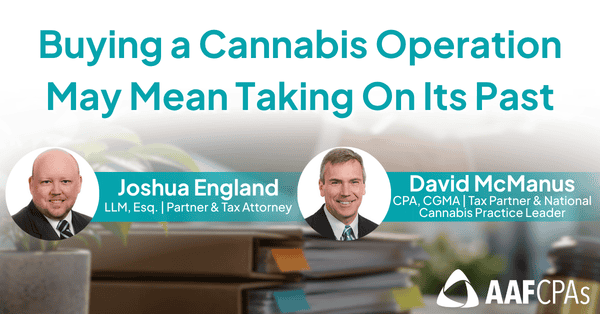
AAFCPAs Tax Specialist Josh England was invited to appear on the May 5th episode of Radio Entrepreneurs’ Cannabis show “In the Weeds” alongside host Jeffrey Davis and Attorney Walter Sullivan.
Radio Entrepreneurs is a business talk show that brings to light the inspiring and astounding stories behind successful entrepreneurs. In this broadcast, Josh shares strategies for navigating some of the unique challenges cannabis businesses face, including: tax planning and preparation; options for corporate business structure; financing structures; business operations; and more.
The full broadcast (10 min, 30 sec) is available for streaming OnDemand here >>
AAFCPAs’ proven Cannabis expertise makes us uniquely qualified to assist cannabis businesses in navigating through the complexities of the industry.
If you have any questions please contact: Josh England, Esq., LLM at 774.512.4109, jengland@aafcpa.com, or your AAFCPAs Partner.
Related Content:
The SAFE Banking Act of 2019 Scores Victorious Step for Cannabis Businesses
On March 28, 2019, the House Financial Services Committee voted 45-15 to advance the Secure and Fair Enforcement Banking Act of 2019 (“SAFE Banking Act”) to the House of Representatives. While there is still a long road ahead, this is the most promising step forward for cannabis businesses who would like to move away from cash-only transactions and towards mainstream banking.
AAFCPAs’ Jeffrey Mead, CPA, CGMA and Olga Yasinnik, MBA, CPA will present a 4-hour ethics CPE course on Building Ethical Management & Culture at FEI-Boston’s June 20th Ethics Symposium.
This course is based on the AICPA Code of Professional Conduct and will cover the conceptual framework, as well as the rules and interpretations applicable to CPAs.
Jeff and Olga will provide a detailed overview of the ethics standards that apply to CPAs in business and industry. This includes: addressing differences with your employer; objectivity and independence standards; conflicts of interests; gifts or entertainment from company vendors or customers competence due care; and, the ethical decision-making model.
Additionally, public practice CPAs will be able to recognize threats to compliance, and associate professional situations with the rules, interpretations and safeguards to determine ethical compliance.
When:
Thursday, June 20th, 2019
7:30AM: Networking Welcome
8:00AM-12:00PM: Presentation
Where:
Babson College, 231 Forrest Street, Olin Hall
Babson Park, MA
This training qualifies for 4 ethics CPE credits for CPAs and is complimentary to FEI-Boston members and prospective members. Please feel free to spread the word to anyone who may benefit from the sharing of this insight. Click here to reserve your seat. >>

Jeffrey E. Mead, CPA, CGMA, Audit Partner, AAFCPAs
Jeffrey is a Partner and leader of AAFCPAs’ Commercial Practice, providing proactive audit/assurance, tax, and advisory solutions for closely-held and privately-owned businesses. Read Jeff’s full profile.>>

Olga Yasinnik, MBA, CPA, Manager, AAFCPAs
Olga specializes in driving high-energy audit teams, and advising sophisticated nonprofit organizations, including multi-services human & social services providers, community development corporations (CDCs) and their affordable housing development projects. Read Olga’s full profile.>>
About Financial Executives International (FEI)
AAFCPAs is a proud sponsor of FEI-Boston, where Finance Professionals gather to share their knowledge, learn, network, and grow. Financial Executives International is the leading advocate for the views of corporate financial management. Its more than 10,000 members hold policy-making positions as chief financial officers, treasurers and controllers at companies from every major industry. FEI enhances member professional development through peer networking, career management services, conferences, research and publications. Members participate in the activities of 74 chapters in the U.S. and a chapter in Japan.
On March 28, 2019, the House Financial Services Committee voted 45-15 to advance the Secure and Fair Enforcement Banking Act of 2019 (“SAFE Banking Act”) to the House of Representatives. While there is still a long road ahead, this is the most promising step forward for cannabis businesses who would like to move away from cash-only transactions and towards mainstream banking.
What Does the SAFE Banking Act Provide?
Currently, in Massachusetts, only two banks have publicly disclosed that they will work with recreational cannabis businesses, GFA Federal Credit Union and BayCoast Bank.
Section 1 of the SAFE Banking Act addresses the obvious concerns for cannabis businesses holding large amounts of cash on hand by detailing that its purpose is to “increase public safety by expanding financial services to cannabis-related legitimate business and service providers and reducing the amount of cash at such businesses.”
The SAFE Banking Act will bar a Federal Banking Regulator from:
- Terminating a bank’s FDIC deposit insurance if they accept funds from a cannabis business;
- Prohibiting, penalizing, or discouraging a bank from providing financial services to a cannabis business;
- Recommending, incentivizing, or encouraging a bank not to offer services to a cannabis business;
- Taking any adverse or corrective action on a loan made to a cannabis related business; or
- Prohibiting, in any way, a bank from performing services for a cannabis business.
Most importantly above, banks would not be at risk from losing their FDIC deposit insurance for accepting funds from cannabis businesses, a risk that most banks up to this point have not been willing to take.
How Would These Changes Affect Cannabis Businesses?
If the SAFE Banking Act were to pass, it is likely that many more banks would take in cannabis businesses. This could in turn drive down the costs of banking for these businesses, which, at this time, is extremely high due to the relatively few banks willing to accept them.
Additionally, reducing the demand on cashless transactions would allow cannabis businesses to keep more accurate records and reporting, which would be invaluable should the IRS audit the business.
Protections for Ancillary Businesses
Section 3. Protections for Ancillary Businesses in the SAFE Banking Act provides protection for ancillary cannabis businesses by stating that “proceeds from a transaction conducted by a cannabis-related legitimate business or service provider shall not be considered as proceeds from an unlawful activity solely because the transaction was conducted by a cannabis-related legitimate business.” This provision protects businesses such as real estate owners, accounting and legal firms, and other venders from prosecution simply for working with cannabis businesses.
Will the SAFE Banking Act Become Law?
There is still a long way to go until the SAFE Banking Act becomes law. Most observers believe that it will pass in the House of Representatives but its fate in the Senate is less certain.
What Does AAFCPAs Advise?
Regardless of whether the SAFE Banking Act is passed into the law, it is very possible that more banks will begin to take in cannabis businesses due to the support and progress of the bill. What this bill won’t provide is federal bankruptcy protection to cannabis businesses, so access to loans will remain difficult.
Banking reform seems to be inevitable for the cannabis industry, and even if this bill does not ultimately pass, safer banking conditions seem to be coming sooner rather than later and cannabis businesses should begin reaching out to their local banks.
AAFCPAs has a proven track record of effectively advising the Massachusetts cannabis industry on: tax planning and preparation; entity structure; financing structures; audit and assurance; business plans; development of the state’s management and operations profile; financial projections; cost allocations; accounting operations; and more. Our proven Cannabis expertise makes us uniquely qualified to assist cannabis businesses in navigating through the complexities of the industry.
Update: On March 8, 38 Attorneys General signed a letter supporting the SAFE Banking Act and calling for progress on the topic. Read more here.
The Cannabis practice of AAFCPAs will continue to monitor the legislative process and keep you informed as significant changes occur. If you have any questions please contact: Christopher Consoletti, Esq. at 774.512.4180, cconsoletti@aafcpa.com; David McManus, CPA, CGMA at 774.512.4014, dmcmanus@aafcpa.com; or your AAFCPAs Partner.

AAFCPAs is excited to announce that Lauren Duplin, CPA and Tracy LeMaire, CPA, MBA have been appointed and agree to serve on the Board of Directors and Finance Committee at Girls on the Run, Worcester County, an organization that inspires girls to be joyful, healthy, and confident. Lauren and Tracy will also serve as co-treasurer of the organization and will exercise due diligence to ensure the organization remains well-managed, financially stable, and sustainable.
Lauren is a leader in AAFCPAs’ Nonprofit Audit/Assurance practice, a career coach through AAF’s Professional Accounting Development program, and an in-house trainer on diverse audit and compliance topics. Lauren is also an active member of AAFCPAs’ Women’s Opportunity Network, committed to mentoring fellow women colleagues to thrive. She is a past winner of the firm’s peer-nominated Excellence in Client Service award, which recognizes exceptional effort from those who exemplify the firm’s core values. Lauren lives in Worcester with her husband Ed. Read Lauren’s full profile. >>
Tracy is a leader in the firm’s Commercial Audit/Assurance practice, Compilation and Review practice, and Revenue Recognition Task Force. She is member of the Executive Committee of AAFCPAs’ Women’s Opportunity Network, leading initiatives to keep women joyful in their work at AAF, and to grow as professionals, leaders and mentors. Tracy was recently honored as a recipient of the New England Society of Certified Public Accountants (NECPAs) 10th Annual Women to Watch Awards, Emerging Leaders category. She lives in Worcester County with her husband Mat and their confident, joyful daughter. In her spare time, she’s a runner, golfer, and respected mentor.
Tracy and Lauren will contribute their financial expertise as a way of living one of AAFCPAs’ core values: Community Service. Our team members deeply care about the communities where we live and work.
About Girls on the Run
Girls on the Run is a 501(c)3 nonprofit organization dedicated to creating a world where every girl knows and activates her limitless potential and is free to boldly pursue her dreams. Learn more about Girls on the Run. >>
AAFCPAs has sent a letter to Congressman Richard Neal (D-Mass.), Chair of the tax-writing Ways and Means Committee, asking him to lend his support to nonprofits by helping to repeal Internal Revenue Code Section 512(a)(7). Section 512(a)(7) of the new tax code requires nonprofits to now pay a burdensome tax on parking and transportation fringe benefits provided to employees.
AAFCPAs has followed this legislation closely and witnessed first-hand the monumental impact this new tax has had on our regional, multi-state, national, and international nonprofit clients.
“Organizations are tax-exempt for a reason: to optimize their abilities to benefit society and provide services that the government might otherwise be required to offer,” wrote Carla McCall & David McManus, AAFCPAs Co-Managing Partners. “This tax is counterproductive and affects the viability and effectiveness of these nonprofit organizations.”
In an illustrated example, AAFCPAs explains the impact in detail on these already resource-constrained organizations. AAFCPAs emphasized the urgent need for Congress to act immediately to repeal the tax.
You may read the complete letter here.>>
If you have questions, please contact our Co-Managing Partners Carla McCall, CPA, CGMA at 774.512.4049, cmccall@aafcpa.com; Dave McManus, CPA, CGMA at 774.512.4014, dmcmanus@aafcpa.com; or your AAFCPAs Partner.
AAFCPAs reminds our clients who have an annual FBAR filing requirement to be sure to report their foreign assets by the IRS’ April 15, 2019 deadline.
Similar to prior years, automatic relief is available. The IRS and US Treasury recently announced that the Financial Crimes Enforcement Network (FinCEN) will now grant filers missing the April 15 deadline an automatic extension until October 15, 2019 to file the FBAR. Specific extension requests are not required.
What is the FBAR?
The “FBAR” is the Report of Foreign Bank and Financial Accounts Form 114 that must be filed with FinCEN, which is a bureau of the US Treasury Department.
Who Needs to File?
All taxpayers with foreign assets need to review this requirement to determine if they need to file. Specifically, any direct, or in certain cases, indirect interest in, or signature or other authority over, foreign financial accounts whose aggregate value exceeded $10,000 at any time during the tax year requires reporting and filing of the FBAR. The FBAR Form 114 is not part of filing your tax return and must be separately filed directly with FinCEN.
Please do not ignore the (extended) October 15 Filing Requirement as the Civil and Criminal Penalties for failure to file could be extensive. The maximum penalty for a non-willful violation is $10,000 and for a willful violation is the greater of $100,000 or 50% of the balance of the account at the time of violation.
AAFCPAs Can Help
AAFCPAs has extensive knowledge of the FBAR filing requirements and can provide guidance in determining whether you need to file and what information is required. As always, we are also able to assist with the preparation and e-filing of the required forms.
If you have questions please contact Richard Weiner, CPA, MST at 774.512.4078, rweiner@aafcpa.com, or your AAFCPAs Partner.

AAFCPAs Partner Jack Finning, CPA, CGMA will serve on a CPA & Consulting panel on April 24th, 2019 in Waltham, MA hosted by the Boston Chapter of the Financial Executives Networking Group (FENG) discussing What CEOs and CFOs are expecting of their CPA firms.
“Companies turn to AAFCPAs to assist them in all kinds of critical functions beyond core financial compliance and reporting, including cyber & IT security, business process improvement, and business exit strategy planning,” says Jack Finning.
Businesses continue to be propelled forward by the rapid pace of change and must seize opportunities presented by factors such as: big data, advanced & emerging technology, and globalization. Additionally, clients continue to be challenged by resource and bandwidth limitations. AAFCPAs is an increasingly sought-after resource to help our clients keep up, push ahead, and thrive.
The Center for Health Information and Analysis (CHIA) announced Friday that they are extending the deadline for all Community Health Centers (CHCs) to file their fiscal year 2018 cost report to Monday, July 8, 2019.
All Massachusetts CHCs, regardless of Fiscal Year End (FYE) date, are required to file their fiscal year 2018 cost report by July 8, 2019. No additional extensions will be granted beyond the July 8, 2019 date.
The depth of AAFCPAs’ Healthcare Practice enables us to easily mobilize the resources of our team, and we are confident we are capable of meeting your needs for the July 8th deadline.
AAFCPAs’ Cost Report Expertise
AAFCPAs is deeply familiar with the instructions and the most beneficial ways to minimize the effort necessary to prepare, while maximizing reporting to properly reflect your true cost of care. We understand the key objectives of the report and critical areas of focus, so we are regularly called upon by the Massachusetts League of Community Health Centers to provide guidance. Because we serve the vast majority of CHCs in the state, we are able to ensure consistency of costs with peers to avoid outliers. Additionally, our close and respectful working relationship with CHIA aids in our research of complex matters.
If you have questions, please contact: Courtney McFarland, CPA, MSA at 774.512.4051, cmcfarland@aafcpa.com; Matt Hutt, CPA, CGMA at 774.512.4043, mhutt@aafcpa.com; or your AAFCPAs Partner.
AAFCPAs Partner Janice O’Reilly, CPA, CGMA and Manager Dawn Pantano, CPA, CITP will present a professional development session on the Futuristic CFO at FEI-Boston’s April 26th Professional Development Event.
The role of the CFO is evolving, and the unique skills required of CFOs will continue to position them as a valuable, strategic resource to executive leadership and one that may be leveraged across departmental lines. CEOs will continue to rely on their CFO to help them improve profitability, manage the business, complement their skills, and offer leadership. CFOs will continue to be challenged by resource and bandwidth limitations. They must commit to a culture of ongoing process improvement in order to be effective, efficient, and to stay nimble in this evolving landscape. They need to overcome resource challenges in order to execute on priorities. Additionally, they must continue to invest in the next generation of great leaders and leverage technology.
“It is not the strongest, nor the most intelligent that survives. It is the one that is most adaptive to change.” – Charles Darwin
Attendees will network with fellow senior financial executives, and gain insight into best practices for the futuristic CFO, including:
- Ensuring you have the right number of team members and the right variety of skill sets to guarantee top performance.
- Ensuring your business processes are optimized for efficiency, effectiveness, and internal control—which are often competing priorities.
- Ensuring you have the right IT systems in place, and that you are quantifying and optimizing ROI on technology investments.
When:
Friday, April 26, 2019
7:00AM – 9:00AM
Where:
Babson College, 231 Forrest Street, Malloy 101
Babson Park, MA
Click here to reserve your seat. >>
AAFCPAs is a proud sponsor of FEI-Boston, where Finance Professionals gather to share their knowledge, learn, network, and grow. Please feel free to spread the word to anyone who may benefit from the sharing of this insight.
About Financial Executives International (FEI)
Financial Executives International is the leading advocate for the views of corporate financial management. Its more than 10,000 members hold policy-making positions as chief financial officers, treasurers and controllers at companies from every major industry. FEI enhances member professional development through peer networking, career management services, conferences, research and publications. Members participate in the activities of 74 chapters in the U.S. and a chapter in Japan.