AAFCPAs supported Boston Senior Home Care in modernizing authorization tracking through intelligent automation, enabling proactive oversight, improved staff efficiency, and meaningful reductions in claim denials.
At a Glance: From Manual PDFs to Proactive Oversight
Managing claim denials depends heavily on accurate, timely authorization tracking, yet many organizations still rely on fragmented manual processes.
Boston Senior Home Care addressed this challenge through intelligent automation, reducing monthly claim denials and transforming a previously manual authorization process that tracked hundreds of PDF approvals each month. This approach improved visibility into expiring and missing authorizations, supported staff efficiency, and shifted authorization management from reactive follow-up to proactive oversight that helps protect revenue and maintain continuity of care.
This turnaround didn’t happen overnight, but the results speak for themselves. Here’s how Boston Senior Home Care partnered with AAFCPAs to automate their authorization process and create a replicable model that’s catching attention across Massachusetts.
Boston Senior Home Care is a private nonprofit providing home care, case management, and long-term services that support individuals in remaining in their communities. As one of Massachusetts’ 24 Aging Services Access Points (ASAPs), the organization manages a high volume of service authorizations across multiple insurance providers.
Historically, authorizations were received only in paper and PDF formats, requiring staff to manually review hundreds of documents to identify approved units and expiration dates. Without structured data or reporting, visibility was limited, increasing the risk of services being delivered without valid authorization and contributing to claim denials and lost revenue. “We had no systematic way to track or manage authorizations beyond static PDFs,” said Margaret Hogan, Chief Executive Officer of Boston Senior Home Care.
The Challenge: Managing High-Volume Insurance Authorizations in Home Care
700+ Monthly Authorizations — and No Way to Track Them
Boston Senior Home Care faced several operational constraints that limited efficiency and created financial risk. Each month, the organization received roughly 700 authorizations, most of which were in PDF format. Staff members could only process a quarter of these on time due to the sheer volume and the manual nature of the work. Without a reporting mechanism, it was difficult to track expiring or incomplete authorizations, and services were sometimes provided without proper approval.
The Cost of Inaction: $65,000 in Monthly Denials
On top of inconvenience and inefficiency, financial stakes were significant. Claim denials averaged $65,000 per month, and the organization carried nearly $1 million in long-term bad debt. Manual processes placed additional strain on staff, who were often blamed for delays beyond their control. “Imagine trying to manage the flutter of thousands and thousands of PDFs every month,” Margaret continued, describing the daily challenges faced by case managers. “It was overwhelming, and there was no practical way to track what was approved or missing.”
The organization knew opportunities existed to reduce risk, preserve revenue, and improve operations. They reached out to AAFCPAs, who recommended automating authorization processing and consolidating data into a centralized system to improve visibility, allow proactive management of approvals, and free staff to focus on client care.
The Solution: AI-Powered Authorization Automation
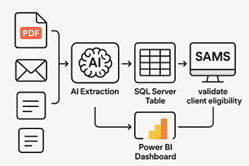
Working with AAFCPAs, Boston Senior Home Care implemented an end-to-end automation solution that combined AI, database management, and a dashboard to manage service authorizations more efficiently. A dedicated email address was created to receive forwarded authorization emails, which triggered the automation process. AI then extracted data from PDFs and email content, handling both structured and semi-structured formats, and populated a centralized SQL Server database, a database management system designed to store, retrieve, and manage data efficiently. This database now serves as a single repository for all authorization details, enabling consistent tracking and reporting.
The system was integrated with a Microsoft Power BI dashboard to provide real-time visualization of authorization status. This provides staff with visibility into expiring approvals, incomplete authorizations, and pending renewals at a glance, with color-coded alerts highlighting items that require immediate attention. Filters help the team prioritize workloads and act proactively rather than reacting to missed deadlines. Additionally, the SQL Server database communicates with the WellSky Aging and Disability Database (formerly known as SAMS) system to validate client eligibility, ensuring comprehensive oversight across multiple platforms.
From AI Data Extraction to SQL Server, Power BI, and SAMS ValidationThis diagram illustrates how authorization emails and PDFs move through the automation process, with AI extracting key data, SQL server storing the information, Power BI presenting it in dashboards, and the SAMS system validating client eligibility.
“Now we can monitor everything, what’s expiring, what’s missing a signature—and run comprehensive reports on authorizations,” said Margaret Hogan, Chief Executive Officer. “That visibility has been a game changer for us.”
The Results: Fewer Denials, Stronger Oversight
AAFCPAs transformed how Boston Senior Home Care manages service authorizations with a customized automation solution. The system now automatically processes 100 percent of authorization emails from participating insurers, compared with just 25 percent previously handled manually. Staff are now free of mundane, repetitive tasks and can devote more time to direct client care and proactive follow-up, boosting both efficiency and morale.
Post implementation financial results were also substantial. Specifically, monthly claim denials dropped from $65,000 to $6,000, producing a clear return on their implementation cost. By reducing denied claims and preventing revenue leakage, the organization strengthened its financial position while minimizing the risk of bad debt. Hogan described the improvement as significant, noting, “When you see how much revenue we stopped from slipping through the cracks, the return is clear—and ongoing. It is not just about recovering money we were losing. It is about giving our staff the tools to manage authorizations reliably and proactively. I’ve recommended this approach to other ASAPs because it works.”
Financial Impact Over Time
In addition to revenue recovery, operational oversight also improved. The new dashboard provides staff with visibility into expiring or incomplete authorizations, allowing them to address issues before they affect reimbursements. Enhanced reporting reduces compliance risk, ensuring all services delivered are properly authorized and documented. At the payer level, results were also measurable. For one Senior Care Options plan, Boston Senior Home Care reduced its claims denial rate from 11 percent to 1.8 percent following implementation.
What This Means for ASAPs and Healthcare Organizations
Boston Senior Home Care’s transformation demonstrates what becomes possible when ASAPs embrace intelligent automation. The results—90 percent reduction in claim denials, $59,000 in monthly savings, and staff finally freed from administrative overwhelm—represent more than operational improvements. They signal a fundamental shift toward sustainable, client-focused care delivery.
This isn’t a one-off success story. The same pressures Boston Senior Home Care faced—overwhelming PDF volumes, manual tracking systems, and staff stretched beyond capacity—challenge ASAPs nationwide. Yet their solution proves these obstacles aren’t inevitable. The combination of robotic process automation, AI, and business intelligence creates a replicable framework that can be adapted to any organization’s specific authorization workflows and payer requirements.
The question for leadership teams becomes clear: How long will you accept $65,000 monthly losses and staff burnout when proven alternatives exist? Boston Senior Home Care’s partnership with AAFCPAs created a roadmap that transforms authorization chaos into competitive advantage.
A Path Forward for ASAP Leadership
For ASAPs ready to move beyond crisis management, the path forward starts with a single conversation about what automation could mean for your organization’s financial health and your team’s daily experience.
“It really made an enormous difference for our organization. Monthly claim denials fell from $65,000 to $6,000. The system helps us manage approvals efficiently, reduce risk, and focus on serving our clients,” said Margaret Hogan, Chief Executive Officer.
Optimize Your Business Processes for Measurable Success
Integrating the transformative power of Automation and Data Analytics, AAFCPAs provides a unique competitive advantage to our clients by embedding the strategic insights and financial acumen of experienced consulting CFOs directly into our practice. This approach ensures that our solutions not only leverage the latest in technology but are also finely tuned to the nuanced needs of finance functions and strategic financial leadership.
Partner with AAFCPAs today and let our proven expertise drive your company’s growth and efficiency. Contact us now to get started!
Watch AAFCPAs’ Partner of Business Process,Robyn Leet, along with guests Adam Shuster from Incompass Human Services and AAFCPAs’ Audit Partner Katie Belanger, CPA, speak on overcoming common system integration challenges in health and human services organizations. Learn ways to integrate billing and ERP systems with accounting and GL systems and how to simplify state and federal reporting requirements. Speakers will cover system integrations, grant and contract management, cost center allocations, budgeting, monitoring, and reporting.
What You’ll Learn
Integration Strategies: Learn how to align your billing and EMR systems, like Epic, with your accounting and GL systems for better data management.
Accounting and Reporting: Get tips on improving accounting and reporting, even when managing multiple programs and technologies.
Compliance Simplified: Learn how to handle state and federal reporting with the right cost center coding and reporting techniques.
Watch Now: Integrating Systems for Human Service Organizations
CFO Insights
Hear firsthand from Adam Shuster, an experienced human services CFO, about their journey towards system and process integration along with the transformative impact it has had on their organization.
This webinar is designed to equip you with the knowledge to assess your current processes and systems and chart the best path toward improved accounting, reporting, and overall operational efficiency.
Meet the Speakers
Katie Belanger, CPA, Partner at AAFCPAs
Adam Shuster, Chief Financial Officer at Incompass Human Services
Robyn Leet, Partner, Business Process Assessments & Attestations
Unlocking the CFO’s Role in Digital Transformation | Webinar OnDemand
Watch AAFCPAs’ Fractional CFOs and Business Process Architects as they embark on a journey to empower attendees with actionable insights and strategies to enhance their finance function. Given the CFO’s pivotal role in driving efficiency and data-informed insight, we’ll help attendees set the stage for digital transformation. We’ll explore the ever-evolving landscape of emerging technologies, including AI, RPA, and leading innovations showcased at the 2023 Digital CPA conference. Our experts will provide you with a roadmap tailored to your starting point, ensuring you stay ahead of the curve in this era of rapid technological advancement. Our goal is to leave you feeling empowered and less overwhelmed. Learn how to kickstart your digital finance journey, become a change champion within your organization, and make informed decisions when selecting the right systems for your unique environment. By the end of this seminar, you’ll gain a solid understanding of how these efforts can enhance decision-making, boost productivity, improve forecasting, and ultimately amplify your organization’s impact.
Webinar OnDemand
Accounting transformation is driven by people who envision what’s possible. If you understand the power of RPA, you can make a list a mile long of potential transformations in how we do our work.
In this webcast, recorded April 2023 at AAFCPAs’ Nonprofit Educational Seminar, Vassilis Kontoglis from AAFCPAs’ Business Process & IT Advisory Practice provides insight and real case examples on how RPA is transforming client operations!
Ideally, your software should include all the core accounting features and functionality you need, including the ability to easily budget to department and person if necessary. In this webcast, recorded April 2023 at AAFCPAs’ Nonprofit Educational Seminar, AAFCPAs reviews system requirements that are proven to save management considerable time. We also demonstrate how efficiencies and collaboration may be achieved without reverting to excel.
How MGCC Distributed ~$700 million to 15,000+ Small Businesses in ~4 Months
Massachusetts Growth Capital Corporation (MGCC) was charged with standing up a new program to quickly deliver an unprecedented amount of relief to small businesses across Massachusetts impacted by the pandemic.
Background
Since 2020, MGCC has proudly been the administrator for multiple pandemic relief grant programs and loan funds for the Commonwealth of Massachusetts. This amounted to almost $800 million in grant funding which MGCC would ultimately disburse to over 16,000 small businesses in the Commonwealth.
The process involved the following components:
Receiving applications from business owners
Collecting evidence and paperwork related to applications
Reviewing qualifications and determining whether to issue funds
Checking applicants for specific Federal disbarments
Acquiring signed agreements from selected business owners
Disbursing funds into bank accounts of eligible business owners
Obstacles and Challenges
MGCC received approximately 18,000+ applications over the course of the first four months. The team had to review baseline eligibility and compare each individual application against the government’s Office of Foreign Assets Control (OFAC) sanctions list. (Each round of applications can have hundreds of possible flags that must be investigated.) Once exclusions were weeded out, MGCC had to carefully track the paperwork and approval process and distribute funds to the thousands of eligible applicants.
MGCC distributed approximately $800 million to 16,000+ small businesses in about four months, during some of the most difficult months of the pandemic.
“The importance of the time saved cannot be overstated,” said Neil. “We got the bulk of this money in the hands of small businesses from February to April 2021. It could have been May to July without the solution AAFCPAs helped put in place. Obviously, that couple of months made a significant difference to the state’s hardest hit businesses and their employees.”
Other key benefits of the Solution:
MGCC distributed approximately $800 million to 16,000+ small businesses in about four months, during some of the most difficult months of the pandemic.
Because the human element was reduced, keystroke errors were eliminated, and clerical issues were reduced.
MGCC was able to easily identify and follow-up with applicants who qualified for the funds, but who had accidentally input their email address wrong. They could correct the error and get them the relief they needed.
Personnel assigned to perform the manual tasks were freed up to perform higher value tasks and improve their work efficiencies. The solution eliminated tedious, repetitive, manual, and boring tasks that would have led to frustration in an unprecedented high-stress time.
MGCC would have had to hire, train, supervise, and pay hundreds of temps to achieve anywhere close to the speed they realized with the automated solution.
“AAFCPAs is our auditors, plus” added Martin. “It’s been valuable to be able to tap into the additional resources they have in-house, including business process, robotic process automation, data analytics, and IT security. We call on them and say, ‘here’s the challenge,’ and they say, ‘here’s a solution.’”
The Need for Better Financial Insights
Financial leaders rely on real-time visibility into key performance indicators (KPIs) to drive decisions. When your systems have limitations in how you can visualize your data, your ability to make meaningful decisions is hindered.
The Challenge: Manual, Time-Consuming Reporting
Beaver uses Financial Edge and found that their financial reports out of the box were not particularly useful to their decision makers and interested parties. The data presentations did not call attention to or flag important metrics unless transformed and manipulated, which was time consuming. To make the data more useful, finance team members had to extract data from the system into excel, inspect, cleanse, and then transform the data into actionable insights. This was consuming hours of their team members’ productivity time, keeping them from focusing on higher value work like strategic planning.
The Solution: Actionable Visualizations
During an IT General Controls Assessment, AAFCPAs Partner Vassilis Kontoglis discussed these challenges with Beaver’s CFO, Joanne McDaniel. His team recommended a more efficient solution: automating data extraction and visualization with Power BI.
The new system pulls data from multiple sources, stores it in the cloud, and automatically generates meaningful dashboards. Human error and clerical issues were eliminated, and finance staff no longer spend time wrangling spreadsheets.